Parallelized Simulations with rpact

Gernot Wassmer

April 26, 2024

Introduction

  • Project: A Phase III double-blind, randomized, placebo controlled, multi-center trial with adaptive sample size recalculation.
  • Objective: To Evaluate the Efficacy and Safety of a New Therapy with an exponentially distributed endpoint through the usage of the Wilcoxon test.
  • Key Performance Metrics and Requirements from FDA:
    • Achieved power.
    • Expected sample sizes and stopping probabilities.
    • Confidence interval coverage probabilities and bias of estimates.
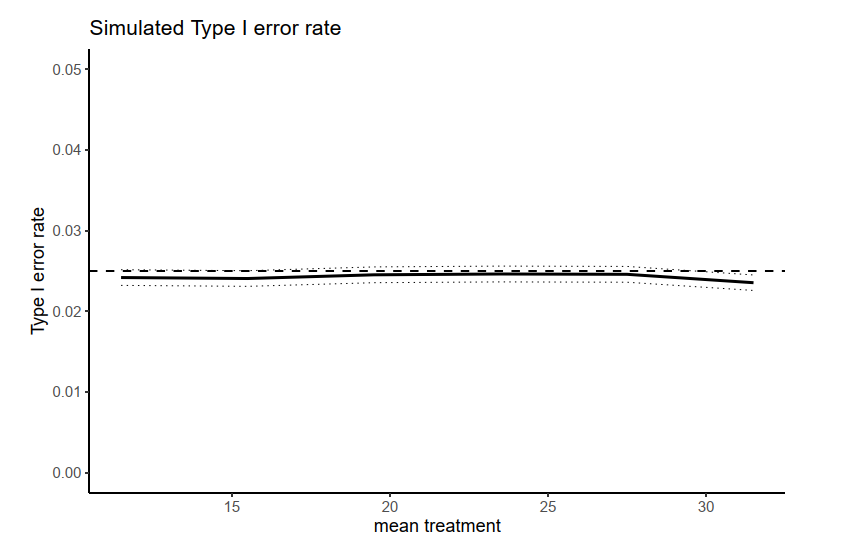
    • Type I error rate control.
  • Simulation with R through utilization of rpact.

Simulation with R

  • Function Developed: getSimulateAdaptiveDesign().
  • Purpose: To simulate test characteristics of the adaptive design with data-driven sample size recalculation.
  • Comparison: Proposed design with a design with and without sample size reassessment
  • Initial Simulation: 10,000 iterations took around 12 hours
    • range of situations to be considered
    • raw data generation
    • wilcox.test(), uniroot(), and getFinalConfidenceInterval() requires capacity

Feedback and Challenges

  • FDA Statistician’s Feedback: Perform the simulation again with 100,000 iterations within a week.
  • Challenge: How to meet the new deadline with the increased computational demand?

Solution: Parallelization

  • Approach: Utilization of R packages ‘parallel’, ‘doSNOW’, and ‘foreach’ for parallelization.
  • Outcome: Enabled completion of the FDA-required simulation within the deadline.
  • New Challenge: Ensuring reproducibility and seed safety of the simulations.

Final Resolution

  • Solution: Utilization of the R package ‘doRNG’.
  • Implementation: Replacing %dopar% commands with %dorng% to ensure seed safety.
  • Result: Successful completion and reproducibility of the simulation, meeting FDA requirements.

Reproducible Simulation Example

#install.packages(c("rpact", "doSNOW", "doRNG", "foreach"))
library(rpact)
library(doRNG)

reproducibleSimulationExample <- function(iterations = 100, seed = 4357829) {
    cores <- parallel::detectCores(logical = FALSE)
    parallelComputingCluster <- parallel::makeCluster(cores)
    on.exit(parallel::stopCluster(parallelComputingCluster), add = TRUE)
    doSNOW::registerDoSNOW(parallelComputingCluster)
    
    alternatives <- seq(0.1, 0.8, 0.1)
    
    set.seed(seed)
    resultLists <- foreach::foreach(
            index = 1:length(alternatives),
            .verbose = FALSE, .packages = c("rpact"),
            .export = c("getSimulationMeans")
        ) %dorng% {
            alternative <- alternatives[index]
            simulatedDesign <- getSimulationMeans(
                alternative = alternative,
                thetaH0 = 0,
                plannedSubjects = 100, 
                maxNumberOfIterations  = iterations) 
            data.frame(
                alternative = alternative,
                power = round(sum(simulatedDesign$overallReject), 5)
            )
        }
    results <- c()
    for (result in resultLists) {
        results <- rbind(results, result)
    }
    results
}

result <- reproducibleSimulationExample(12345)
result
  alternative   power
1         0.1 0.07331
2         0.2 0.16663
3         0.3 0.32539
4         0.4 0.51689
5         0.5 0.71478
6         0.6 0.84642
7         0.7 0.93811
8         0.8 0.98015
# expect TRUE
identical(result, reproducibleSimulationExample(12345))
[1] TRUE
# expect FALSE
identical(result, reproducibleSimulationExample(100))
[1] FALSE

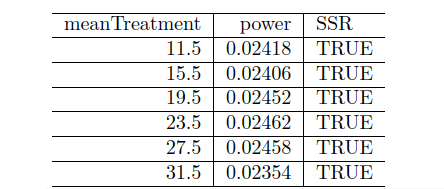
Study Simulation Results

Goal Achieved

100,000 simulations took around 14 hours

Summary

  • rpact is a comprehensive validated package for designing group sequential designs, with a focus on adaptive extensions using the inverse normal method or Fisher’s combination test.
  • Usage supported by extensive documentation and vignettes, ongoing development.
  • RPACT Cloud suitable for learning R commands and rpact as a stand-alone.
  • Computation time can be substantially improved by parallel computing.
  • Rich R extension tools for performing more advanced strategies (e.g., “reproducable results”, promizing zone approach, etc.).
  • Comes along with the more and more accepted usage of R in pharmaceutical research and the transition towards R in many institutions.